
Bitcoin’s clock is not a stopwatch
What a Bitcoin block height tells you—and what it does not.
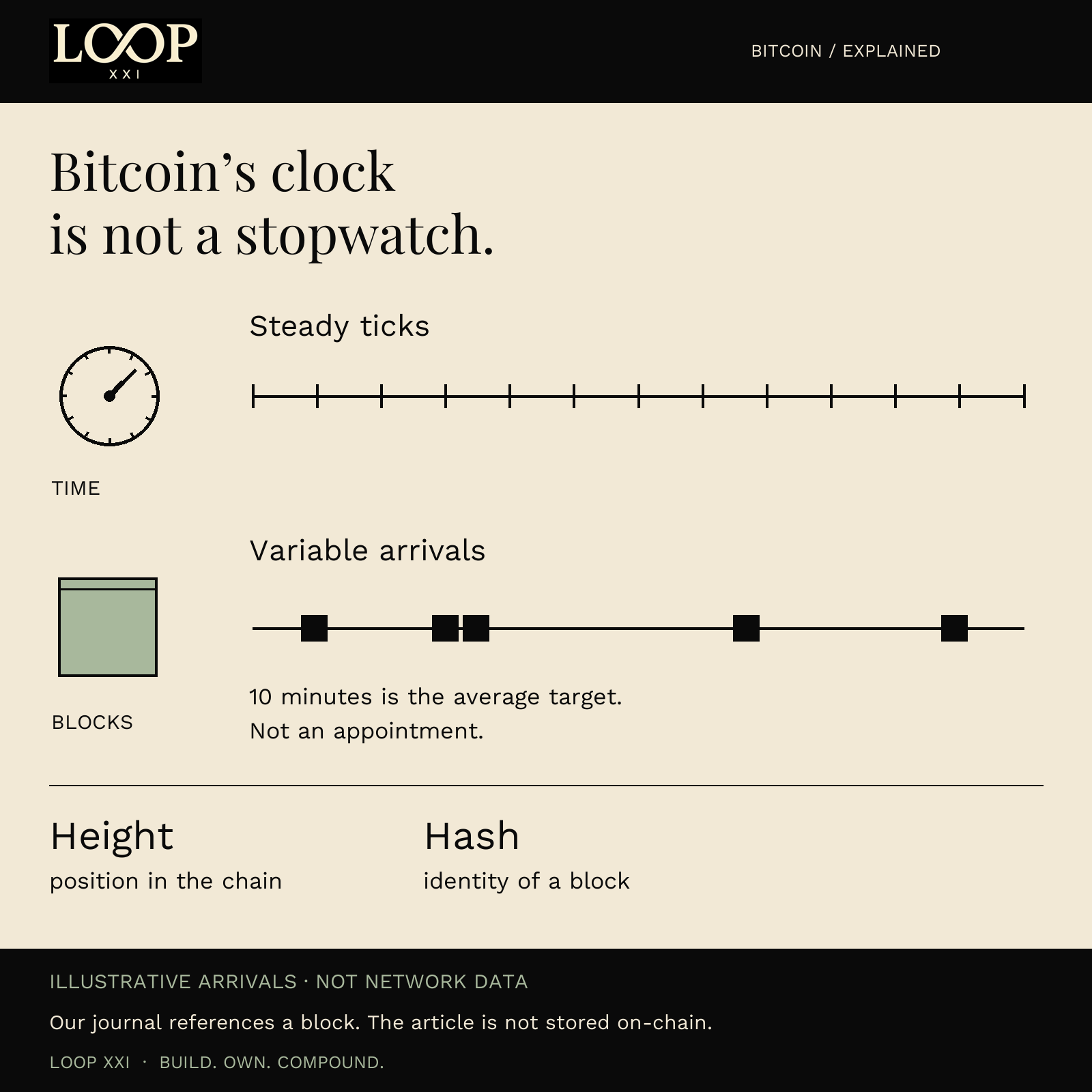
A clock tells you the time. A Bitcoin block height tells you where a block sits in a chain. Both are useful references. Understanding the difference makes the number beside a journal entry more meaningful.
Imagine opening a book at page 250. That number helps you locate a passage, but it cannot tell you when somebody read it. A block height works similarly as a position marker. Bitcoin begins with the genesis block at height zero; later heights count forward from there.
Bitcoin aims for an average interval of roughly ten minutes between blocks. Individual arrivals vary. The difficulty adjustment operates every 2,016 blocks against a two-week target, so an expected rhythm does not become an appointment. A height alone cannot supply an exact calendar time.
That distinction matters when we describe progress. “Another block arrived” is an observation about the chain. “Ten minutes passed” is an observation about a clock. Treating them as interchangeable invites false precision, especially when looking ahead. A forecast can help somebody plan; it should still be labelled as a forecast.
Bitcoin’s original design addresses a different problem: agreeing on transaction history without asking one central record keeper to decide it. The white paper describes linked timestamps and proof of work. Changing a past block requires redoing work, including the work in the blocks that follow it. The mechanism gives the sequence its security purpose; it does more than count passing moments.
There is another detail hidden behind a neat height label. Competing blocks can occupy the same height. Nodes follow the valid chain with the greatest accumulated work, and a block can become stale. The block’s header hash identifies the particular block being discussed. Height is therefore a useful shorthand, but it is not a globally unique identity.
Bitcoin Core makes those distinctions visible. Its block-header response separates height, hash, block time, median time and confirmations. It also reports whether a block is outside the main chain. These are different fields because they answer different questions: where the block sits, which block it is, what time information accompanies it and how it relates to the current chain.
For this journal, a block label should communicate a modest, specific observation: the chain height checked when an issue was released. The supporting publication record should retain the observed hash, observation time and sources. If publication is delayed, the label should come from the actual release check. A draft has no publication height yet.
Printing that number beside an essay does not itself store the essay on Bitcoin, timestamp its contents cryptographically or prove that its arguments are correct. Those would be separate claims requiring separate evidence.
That is the editorial value of the format. It invites us to connect an idea with an observable moment while keeping the observation honest. The number provides context. The writing still has to earn your attention, explain its sources and withstand scrutiny.
Sources
Educational commentary from Loop XXI. The block height records Bitcoin network time at publication.