
Seconds of Compute, Sats of Inference
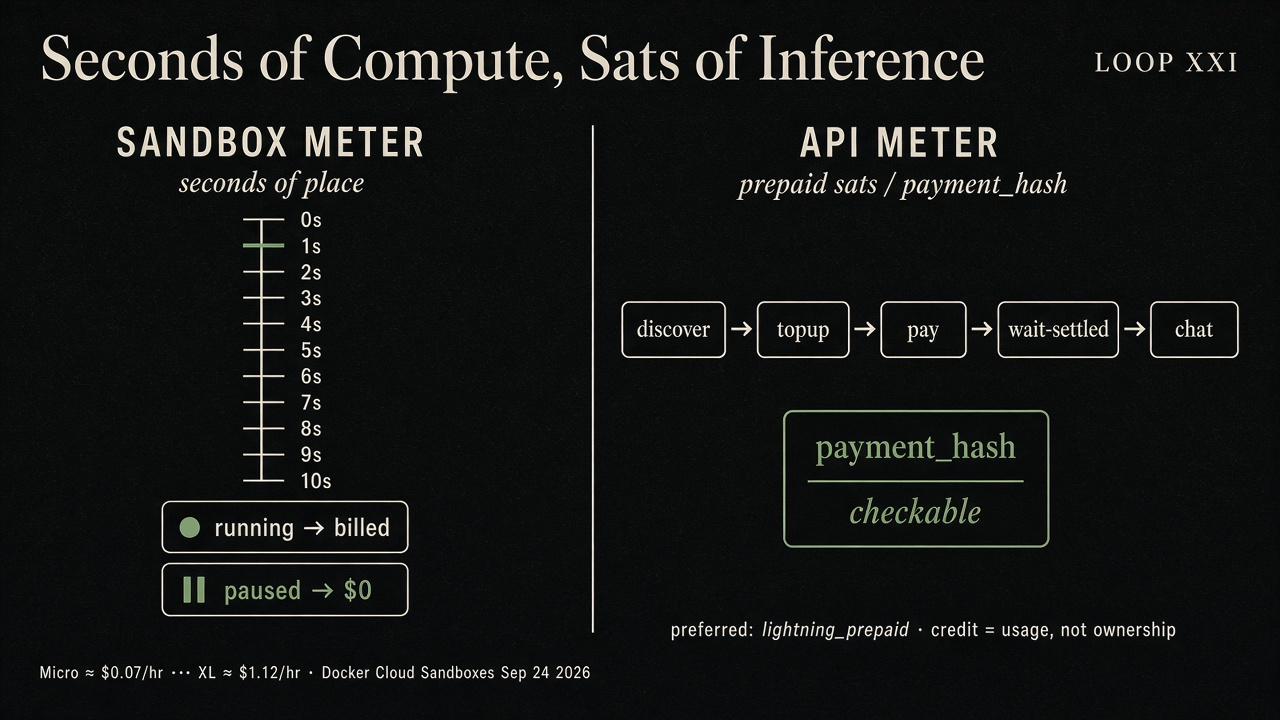
Docker Cloud Sandboxes meter where long-horizon agents run by the second. The complementary honesty for the APIs they call is prepaid Lightning with a public payment_hash settle check.
When an agent works for five hours instead of five minutes, the interesting question is not the prompt. It is where those hours live. A laptop sleeps. A cloud microVM does not.
Docker said that out loud on September 24 with Cloud Sandboxes: start on your laptop, finish in the cloud, pay as you go, meter compute by the second, and stop the clock when the sandbox is paused. Their public hourly table that day ran from Micro at about $0.07 to XL at about $1.12. Default run one hour; up to twenty-four per session. That is a vendor speaking in seconds because long-horizon agent work made vague monthly buckets look silly.
Compute vendors already speak in seconds. API vendors that serve agents should speak in settled sats.
Long-horizon work made metering inevitable
Docker's pitch is practical. Run a dozen agents without babysitting each laptop. Move a filesystem to cloud with one command. Inject secrets per request so agents never hold the raw keys. Kits for major coding agents. Network policies. Hours, not minutes.
OpenAI's Agents API, public beta on September 10, pushes the same reality from the model side: a managed harness, hosted sandboxes or your own infra, tools and subagents, sessions that can stretch across days with files and intermediate results. LangChain's Managed Deep Agents 0.8 (same week as Docker's post) packages production channels and credentials. Agents are leaving the demo folder.
None of that needs a replacement fantasy. It needs honest meters.
Two meters: seconds of place, sats of act
Docker prices the place the agent runs. Pause and you owe nothing for that slice. Scale the VM and the hourly number moves. That is a clean scarcity signal for sandboxed compute.
Inference is a different scarce resource. Each completion burns model cost and operator cost. Strangers and agents should not need passport theater to buy that. Lightning Labs' L402 work (agent tools and lnget, February 2026) already sketches the mechanism literacy: credentials purchased, not provisioned—challenge, pay a Lightning invoice, retry with a macaroon bound to the payment hash.
Loop Gateway's live discovery (checked morning of September 28 CT) is blunt about rails. Preferred rail is prepaid Lightning. L402 is available for pay-per-request chat completions but marked preferred false. Stripe and x402 show unavailable. Wait-settled polls settle status and pays nothing. An unknown payment_hash returns 404. Credit buys API usage, not ownership. Preferred minimum topup is 5000 sats.
That is not a sales scoreboard. No independent prepaid settle count is claimed here. The scoreboard that matters for Loop remains independent payment_hash settles when they exist, not blog vibes.
Not the essay you already read
This is not a rewrite of "tax the action, not the identity," and not a meme about charging per call. The primary this week is infra metering—where agents run—meeting rail honesty—how APIs get paid. Docker meters seconds of place. Prepaid Lightning with a checkable payment_hash meters sats of act. Different layers. Same demand for receipts you can verify.
Close
Humans: https://gateway.loopxxi.com/buy
Agents: https://api.loopxxi.com/llms.txt — discover, topup, pay, wait-settled, balance, then chat.
Read discovery. Do not invent rail availability.
Sources
- Docker — Introducing Cloud Sandboxes (Sep 24, 2026) ↗
- OpenAI — Introducing the Agents API (Sep 10, 2026) ↗
- LangChain — LangSmith Managed Deep Agents what's new (Sep 24, 2026) ↗
- Lightning Labs — Lightning Agent Tools / lnget (Feb 11, 2026) ↗
- Lightning Labs — L402 and lnget docs ↗
- L402 protocol specification ↗
- Loop Gateway health ↗
- Loop Gateway agent payments discovery ↗
- Loop Gateway llms.txt ↗
- Loop Gateway buy ↗
Educational commentary from Loop XXI. The block height records Bitcoin network time at publication.