

How to read a balance sheet in ten minutes
Three questions, in order: can it pay what is due soon, how long can it keep going, and who owns what is left.
What the sheet is
A balance sheet is a photograph of a business on one date. It lists what the business owns (assets), what it owes (liabilities), and what is left for the owners (equity). The two sides always match: assets equal liabilities plus equity. The SEC's beginner guide uses the same three words, and the same equation.
The date matters as much as the numbers. A sheet dated December 31 says nothing about January. Before you read a line, find the date at the top and ask what has changed since.
Question one: can it pay what is due soon?
Look for current assets and current liabilities. Current assets are cash and things the business expects to turn into cash within a year: receivables, inventory, short-term deposits. Current liabilities are bills due within a year: payables, the next twelve months of loan payments, taxes owed, customer prepayments not yet delivered.
Subtract current liabilities from current assets. That is working capital. A positive number means the business can meet the next year of bills from what it already has or expects. A negative number is not always fatal, but it means the business depends on new sales or new money arriving on time.
One refinement: count only cash and receivables, and leave inventory out. Inventory is the slowest current asset to become cash, and it is the first line that gets written down in a bad year.
Question two: how long can it keep going?
The balance sheet gives you cash. The income statement or the bank statements give you how much cash leaves each month, net of what comes in. Divide cash by that monthly net outflow. The answer is runway, in months.
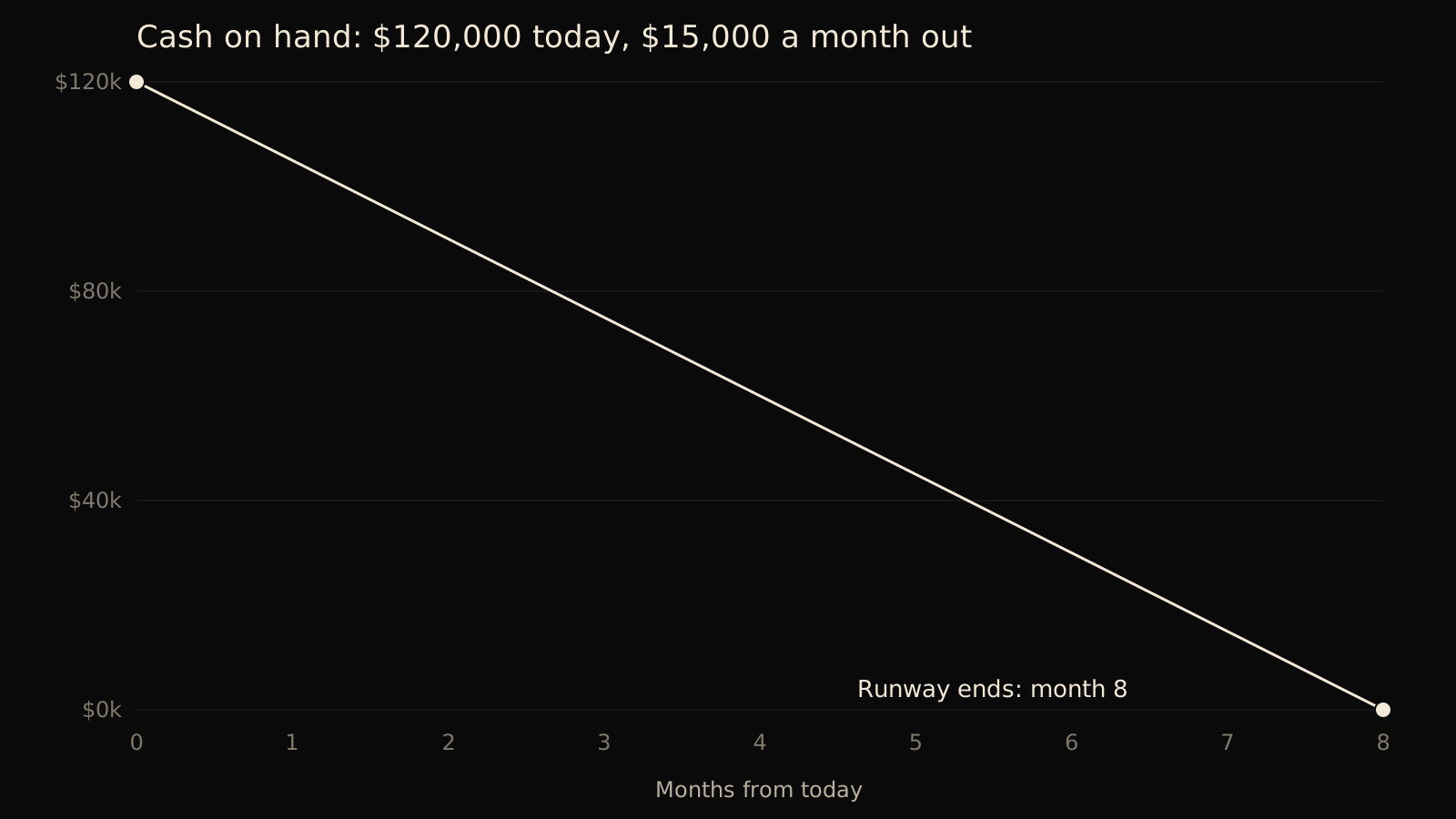
A business with $120,000 in cash that spends $15,000 a month more than it collects has eight months. The chart below is that single division, drawn out. Nothing about it is a forecast; it says what happens if nothing changes, which is the only question the arithmetic can answer.
Question three: who owns what is left?
Below current liabilities sit the long-term ones: loans beyond a year, leases, deferred amounts. Add every liability together and compare it to equity. A business carried mostly by debt has lenders ahead of owners in every bad outcome. A business carried mostly by equity has room to borrow when it needs to.
Equity itself has two parts worth separating: money the owners put in, and profit the business kept. A large retained-earnings line is a business that has paid for itself for years. A small or negative one, next to large paid-in capital, is a business still living on its founders' money.
What the sheet does not tell you
It does not say whether the business is profitable. That is the income statement. It does not say where the cash went. That is the cash flow statement. It does not value the business; book value is cost less depreciation, not what a buyer would pay.
It can also be dressed up for the date. A loan drawn on December 30 and repaid on January 2 makes the year-end cash look large. If a number surprises you, look at the same line three months earlier and three months later.
The ten-minute routine
Read the date. Compute working capital. Compute runway. Compare total liabilities to equity. Read retained earnings. Then write down the one number you would want to see move by next quarter.
Do this on the same day each month and the sheet starts to tell a story instead of a snapshot.
Sources
Educational commentary from Loop XXI. Publication record: Block 974,318.