

Where AI saves time in a small business, and where it does not
AI saves time on a task when checking its work is much quicker than doing the work. One worked example each for sales, customer support and bookkeeping shows where that holds, where it does not, and how to test it on your own tasks.
Checking is part of the job
An AI tool hands you a draft. Someone reads it before it goes to a customer or into the books. So the time a tool saves on a task is the time the task takes by hand, minus the time spent checking each draft, minus the time spent redoing the drafts that were wrong.
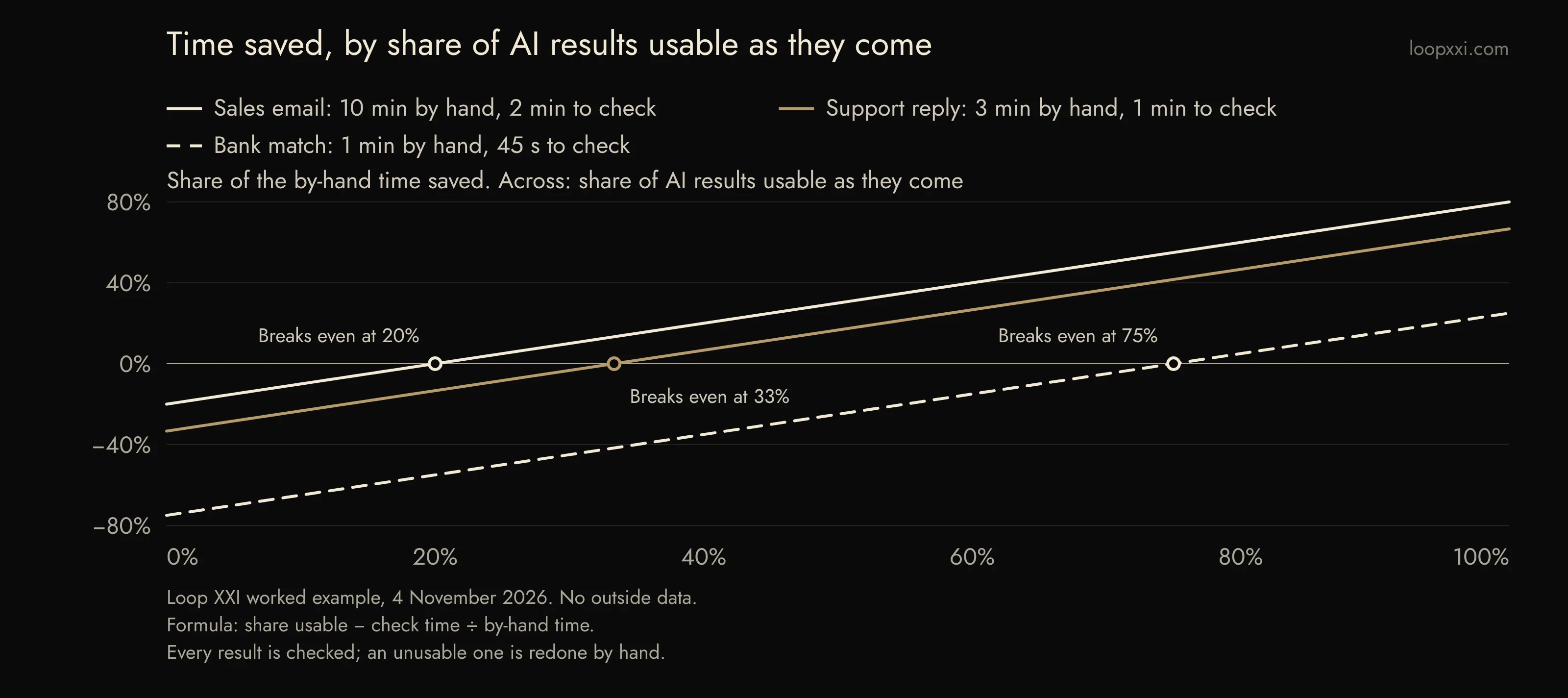
That gives one rule. AI saves time where checking a result is much quicker than producing it. Divide the check time by the by-hand time and you have the break-even: the share of results that must be usable as they come before the tool saves anything. If a reply takes three minutes to write and one minute to check, at least one draft in three has to be usable, or the tool costs time.
The rest of this article applies the rule to one task in sales, one in customer support and one in bookkeeping. The minutes are assumptions chosen to show the arithmetic. Replace them with your own.
Sales: the follow-up email
Take the email you send after a sales call: what was discussed, the next step and a date. Assume it takes ten minutes to write by hand and two minutes to check a draft for names, prices and promises. The break-even is one draft in five.
Writing is where the evidence for AI is strongest. In an experiment published in Science in July 2023, 453 college-educated professionals, among them marketers, consultants and managers, did writing tasks drawn from their jobs. Those given ChatGPT took 40 percent less time, and the graded quality of their work rose 18 percent.
Selling online shows the same split between tasks. A field study on a large online retail platform added AI to seven parts of the business and compared sales with a control group. The largest gain, 16.3 percent more sales, came from an assistant that answered shoppers' questions before they bought. AI-written marketing push messages and advertising titles showed no detectable effect on sales. The authors trace the gains mostly to more shoppers buying, not to larger orders.
Where it does not save time: the call itself, the price you agree to and the relationship. A tool can draft the follow-up, but it only knows what you promised if you tell it. Calling people with an AI voice is also regulated in the United States. In February 2024 the Federal Communications Commission ruled that AI-generated voices count as artificial voices under the Telephone Consumer Protection Act, so those calls need the prior express consent of the person called, unless an emergency or a legal exemption applies.
Customer support: the reply
Take a reply to a customer's question about an order, a booking or a return. Assume three minutes to write by hand and one minute to check a draft against your records. The break-even is one draft in three.
Support is the best-measured use of AI at work. A study of 5,172 customer support agents, published in the Quarterly Journal of Economics in 2025, found that an AI assistant raised the number of issues resolved per hour by 15 percent on average. Newer and less skilled agents gained the most, in both speed and quality. The most experienced agents saw small gains in speed and small declines in quality.
Where it does not save time: anything that commits the business. In February 2024 a British Columbia tribunal held an airline responsible for what its website chatbot told a customer about a bereavement fare. The airline argued it could not be held liable for information from its chatbot. The tribunal found the chatbot was part of the airline's website and ordered the airline to pay the customer 812.02 Canadian dollars, including interest and fees. Treat anything a tool tells a customer as something you said. Refunds, prices and policy questions are where a person should send the reply.
Bookkeeping: the bank match
Take one line on a bank statement, matched to its receipt and given a category. Assume one minute by hand. Checking the tool's match properly means opening the receipt and reading the line, which is most of the same work, so assume 45 seconds. The break-even is three matches in four. Even if every match were right, the tool would save a quarter of the time at most.
Field evidence shows where bookkeeping gains come from. A May 2025 working paper by researchers at Stanford and MIT drew on a survey of 277 accountants and task data from 79 small and mid-sized firms using AI accounting tools. Accountants using AI supported 55 percent more clients each week, closed the books 7.5 days sooner each month and moved about 8.5 percent of their time from routine data entry to work such as business communication and quality checks. Experienced accountants used the automation selectively and stepped in more when the tool signalled it was unsure. Less experienced staff were more likely to accept the tool's output at face value, according to Stanford's summary of the study.
That is the rule at work. A recurring charge from the same supplier can be confirmed at a glance, which brings the average check time down, and the close look goes to the unusual lines. Accepting everything brings the check time to zero and lets the errors through.
Where it does not save time: one-off transactions, anything the tool marks as uncertain, and the month-end reconciliation to the bank balance. The records stay yours. The IRS says business records support the items reported on a tax return, and that taxpayers are ultimately legally responsible for everything on their return, whoever prepares it.
The three side by side
A 2023 experiment involving 758 knowledge workers found the same split. On tasks the AI handled well, workers using it completed 12.2 percent more tasks and worked 25.1 percent faster. On one task chosen to sit just outside what the AI could do, those using it were less likely to reach a correct answer than those working without it. So ask whether a tool is good at this task, and how long it takes to spot when it is not.
The chart puts the three example tasks on one scale: the share of by-hand time saved, by the share of AI results usable as they come. Each line starts below zero, because a result nobody can use still costs the check. Each crosses zero at its break-even: 20 percent for the sales email, 33 percent for the support reply and 75 percent for the bank match. At 80 percent usable, the email saves 60 percent of the time, the reply 47 percent and the bank match 5 percent.
How to test it in your business
Pick one task that repeats every week. Do twenty by hand and time them. Then do twenty with the tool, timing the check and any rewrite, and count the results you used without a rewrite. Your check time divided by your by-hand time is your break-even. If the share you could use sits well above it, the tool saves time on that task.
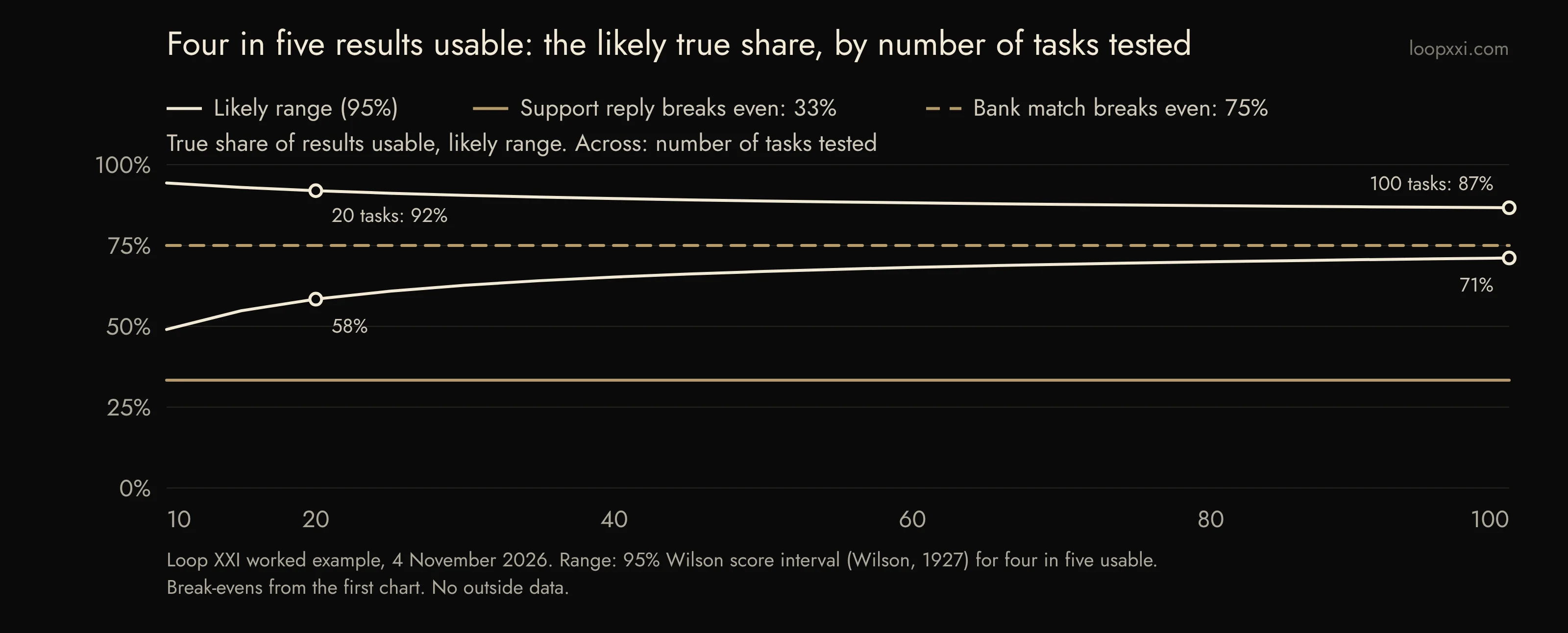
Twenty tries can settle a clear case but not a close one. Say 16 of 20 results were usable, four in five. The true share could reasonably be anywhere from 58 to 92 percent. All of that range sits far above the support reply's 33 percent break-even, so the answer is clear. For the bank match, the 75 percent break-even stays inside the range even after 100 tries, when the range has narrowed to 71 to 87 percent. When a test cannot settle the question, the saving is small either way. Put the effort into tasks where checking is quick.
What to measure
Measure four things before and after: minutes per task, including the check; the share of results used without a rewrite; errors that got past the check and reached a customer or the books; and one result the task exists for.
For sales, that result is replies received or deals moved to the next step. For support, it is the time to first reply and how often the same customer has to write again. For bookkeeping, it is how long the month-end close takes and the differences left when the books are reconciled to the bank.
Keep measuring after you adopt a tool. The share of usable results moves when the tool changes, when your products or prices change, and when someone new does the checking.
What the arithmetic leaves out
It assumes every wrong result is caught. A wrong reply that reaches a customer, or a wrong entry that reaches a tax return, is not in the formula, and it is the cost that hurts most. If the check is skipped, the chart shows a best case, not an estimate.
It also leaves out setup, the hours spent learning the tool and the tool's price. Those belong on their own line. The earlier article on cost per successful task shows how to compare tools by what each usable result costs.
Sources
- Noy and Zhang: Experimental evidence on the productivity effects of generative artificial intelligence, Science, July 2023 ↗
- Fang, Yuan, Zhang, Donati and Sarvary: Generative AI and Firm Productivity: Field Experiments in Online Retail, arXiv, version of 10 February 2026 ↗
- Federal Communications Commission: Declaratory Ruling FCC 24-17 on AI-generated voices under the TCPA, released 8 February 2024 ↗
- Brynjolfsson, Li and Raymond: Generative AI at Work, Quarterly Journal of Economics, 2025 (open version, revised 6 November 2024) ↗
- Civil Resolution Tribunal of British Columbia: Moffatt v. Air Canada, 2024 BCCRT 149, 14 February 2024 ↗
- Choi and Xie: Human + AI in Accounting: Early Evidence from the Field, Stanford GSB Working Paper No. 4261, 7 May 2025 ↗
- Stanford GSB Insights: AI Is Reshaping Accounting Jobs by Doing the Boring Stuff, 26 June 2025 ↗
- IRS: Recordkeeping, small business and self-employed guidance, updated 1 May 2026 ↗
- IRS: Take care when choosing a tax return professional, IR-2024-31, 1 February 2024 ↗
- Dell'Acqua and others: Navigating the Jagged Technological Frontier, Harvard Business School Working Paper 24-013, September 2023 ↗
- Wilson: Probable inference, the law of succession, and statistical inference, Journal of the American Statistical Association, June 1927 ↗
- Loop XXI: Cost per successful task ↗
- Loop XXI research record: assumptions, formulas, hashes and rebuild script ↗
Educational commentary from Loop XXI. Publication record: Block 974,567.